
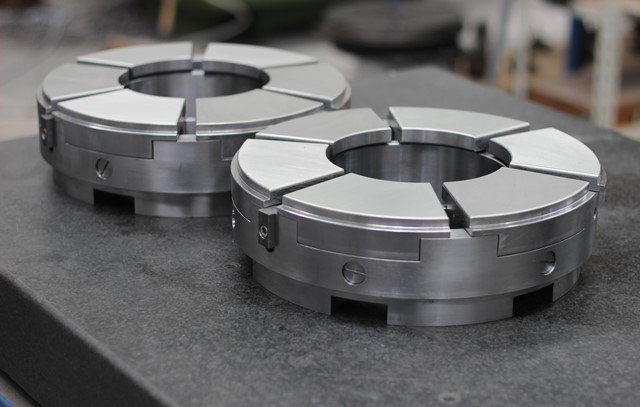
White Metal Bearing Alloys
Whitemetal and Babbitt composition, properties, standards and selection for hydrodynamic bearings.
White metal, whitemetal and Babbitt are commonly used names for the same family of soft bearing alloys. They are used as the running surface in hydrodynamic bearings across turbines, compressors and heavy rotating equipment.
Its unique combination of a soft, conformable matrix with embedded hard phases allows it to support high loads while protecting critical rotating components.
Understanding the composition and properties of white metal bearing alloys is essential for selecting the right material and ensuring reliable performance.
What Is a White Metal or Babbitt Bearing?
Alloy Composition
White metal bearing alloy is typically composed of:
- Tin (Sn) or lead (Pb) as the base metal
- Antimony (Sb) for strength
- Copper (Cu) for hardness and wear resistance
Typical compositions include ~80–90% tin with smaller additions of antimony and copper.
Material Structure
The material structure consists of:
- A soft matrix — providing conformability and embeddability
- Hard intermetallic particles — providing load-carrying capability
This combination makes whitemetal uniquely suited to protecting high-value rotating components.
Why Whitemetal Is Used in Bearings
Low Friction
Enables smooth operation and reduced wear.
Conformability
Adapts to minor shaft misalignment and surface imperfections.
Embeddability
Absorbs contaminants, preventing damage to shafts.
Emergency Running
Provides protection during transient conditions and lubrication issues.
Limitations of Whitemetal
Understanding limitations is just as important as strengths:
Relatively low fatigue strength | Limited temperature capability | Performance dependent on lubrication quality
This is why correct alloy selection and bearing design are critical.
Types of Whitemetal Alloys
Tin-Based Alloys (High Performance)
Used in turbines, compressors and high-speed, high-load applications.
- Higher fatigue resistance
- Better performance at elevated speeds and loads
- Superior reliability in critical applications
Lead-Based Alloys (Cost & Corrosion Focused)
Used in lower load applications and cost-sensitive environments.
- Lower cost
- Improved corrosion resistance in some environments
- Lower fatigue strength and reduced performance under high load/speed
Common Industry Standards
Whitemetal alloys are typically manufactured to international standards, ensuring composition consistency across applications.
BS 3332
ASTM B23
ISO 4381
JIS H5401
Typical Alloy Compositions
| Standard | Tin (Sn) | Antimony (Sb) | Copper (Cu) | Lead (Pb) | Cadmium (Cd) |
|---|---|---|---|---|---|
| BS3332-A | Balance (89%) | 7–8% | 3–4% | 0.3% max | 0.05% |
| BS3332-B | Balance (88%) | 7–8% | 3–4% | 0.3% max | 0.8–1.2% |
| ASTM B23 Grade 2 | 88–90% | 7–8% | 3–4% | — | — |
| UNI 4515-MB80 | 79–81% | 10–12% | 8.25–9.75% | 0.35% max | — |
| JIS H5401 WJ2 | Balance | 8–10% | 5–6% | — | — |
| ISO 4381 SnSb12Cu6Pb | Balance | 11–13% | 5–7% | 1–3% | — |
All values indicative — exact composition depends on specification.
How To Select The Right Alloy
Selection depends on operating conditions:
High speed / high load (turbines, compressors) → Tin-based alloys with higher fatigue resistance
Moderate load / cost-sensitive applications → Lead-based alloys
High temperature or marginal lubrication → Requires careful design and possible material upgrades
In practice, alloy selection is closely linked to bearing geometry, lubrication system and operating environment.
Engineering Considerations
Whitemetal performance is influenced by multiple factors — material selection should not be considered in isolation.
Oil Film Thickness
Typically 25–75 microns in operation.
Load Distribution
Load distribution and alignment.
Lubrication Quality
Lubrication quality and temperature.
Rotor Dynamics
Rotor dynamics and vibration.
At Oiltech, alloy selection is integrated with bearing design and geometry, application-specific operating conditions, and failure analysis and historical performance.
This ensures that materials are not only compliant with standards — but optimised for real-world performance.
Need Help Selecting or Replacing a Bearing Alloy?
Speak to our engineering team for guidance on material selection, performance optimisation or repair.