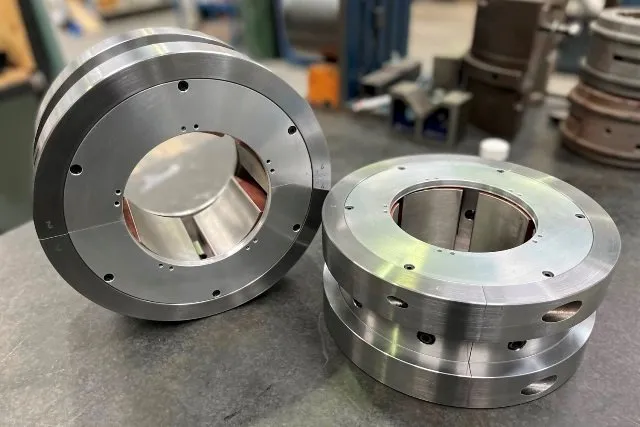
Tilting-pad journal bearings containing copper-chromium-zirconium backed whitemetal pads

Whitemetal Bearing Backing Materials

How steel, bronze and copper-alloy backing changes structural support, heat transfer, distortion and repair.

The Backing Carries the Lining and Completes the Heat Path

A whitemetal or Babbitt bearing is normally a lined construction. The soft alloy forms the compatible running surface, while a stronger backing supports it, transfers hydrodynamic pressure into the shell, carrier or pivot, and conducts heat away from the oil film. Backing material therefore affects hot geometry and bearing performance even though it does not normally contact the shaft or collar. For running-layer alternatives, see the fluid-film bearing material selection guide.

Specify the complete system: whitemetal grade, finished lining thickness, bond or interlayer, backing grade and condition, pivot or support geometry, and inspection requirements.

Layered Construction

Four Functions, One Bearing Pad or Shell

01

Support the soft lining against oil-film pressure and dynamic load.

02

Conduct heat from the lining into the pad body, carrier, oil and housing.

03

Control geometry through stiffness, thermal expansion and pad or shell deformation.

04

Transfer load through a pivot, spherical support, base ring, shell fit or housing seat.

Backing Families

Common Options for Whitemetal Bearings

These are material families, not drawing specifications. Properties can vary substantially with grade, heat treatment, section size and manufacturing route.

Common baseline

Steel

Carbon, mild or alloy steels are widely used for journal shells and tilting pads. They provide stiffness, dimensional control, availability and established casting and repair routes.

  • Strong and structurally efficient
  • Generally economical and readily traceable
  • Lower thermal conductivity than high-copper alloys
  • Grade, cleanliness, heat treatment and weld history matter
Copper-alloy family

Bronze

Selected bronze grades can provide a useful combination of structural support, heat transfer and emergency compatibility beneath a thin whitemetal lining.

  • Conductivity and strength depend strongly on alloy
  • Different expansion and stiffness from steel
  • Copper chemistry may be restricted in some services
  • Do not confuse backing with a solid bronze running surface
High-conductivity option

CuCr / CuCrZr

Copper-chrome and copper-chromium-zirconium are high-copper, precipitation-hardened alloys used where pad temperature and thermal distortion constrain performance.

  • Much stronger heat path than typical steel backing
  • Useful strength in the specified material condition
  • Can support high-speed, high-load pad designs
  • Pivot contact and thermal growth still require analysis
Legacy construction

Cast Iron

Cast-iron shells and bodies occur in older fixed-profile bearings and machinery. Repair starts by identifying the grade, casting integrity, graphite condition and existing bond preparation.

  • Often integral to an established housing geometry
  • Porosity and previous repair history need inspection
  • Bond preparation differs from wrought steel
  • Replacement by another family is a redesign

Screening Comparison

Relative Characteristics

Use certified properties for the actual grade and temperature in calculation. The table is qualitative.

Design factorSteelBronzeCuCr / CuCrZrCast iron
Thermal conductivityModerate to relatively lowGrade-dependent; often higher than steelHigh when supplied in the correct conditionGenerally lower than high-copper alloys
Structural stiffnessHigh modulus and familiar design dataLower modulus than steel; grade-dependent strengthLower modulus than steel but useful precipitation-hardened strengthRigid cast construction; tensile behaviour and defects require care
Thermal distortionCan retain more local heat in a heavily loaded padImproved heat spreading is possibleOften selected specifically to reduce local temperature and distortionDepends on section, graphite structure and housing heat path
Pivot contactWell suited when grade and contact stress are controlledGrade and hardness must suit contact pressureMaterial condition, hardness and contact geometry are criticalUsually associated with shell seating rather than compact pad pivots
Manufacture and repairEstablished machining, lining and repair practiceRequires alloy-specific preparation and process controlRequires traceable alloy, heat-treatment and bonding procedureLegacy casting condition and bond preparation govern feasibility
Typical reason to selectRobust general-purpose backingThermal or compatibility benefit in a proven constructionHigh-speed or high-load duty limited by pad temperatureRestoration of an established legacy shell or housing
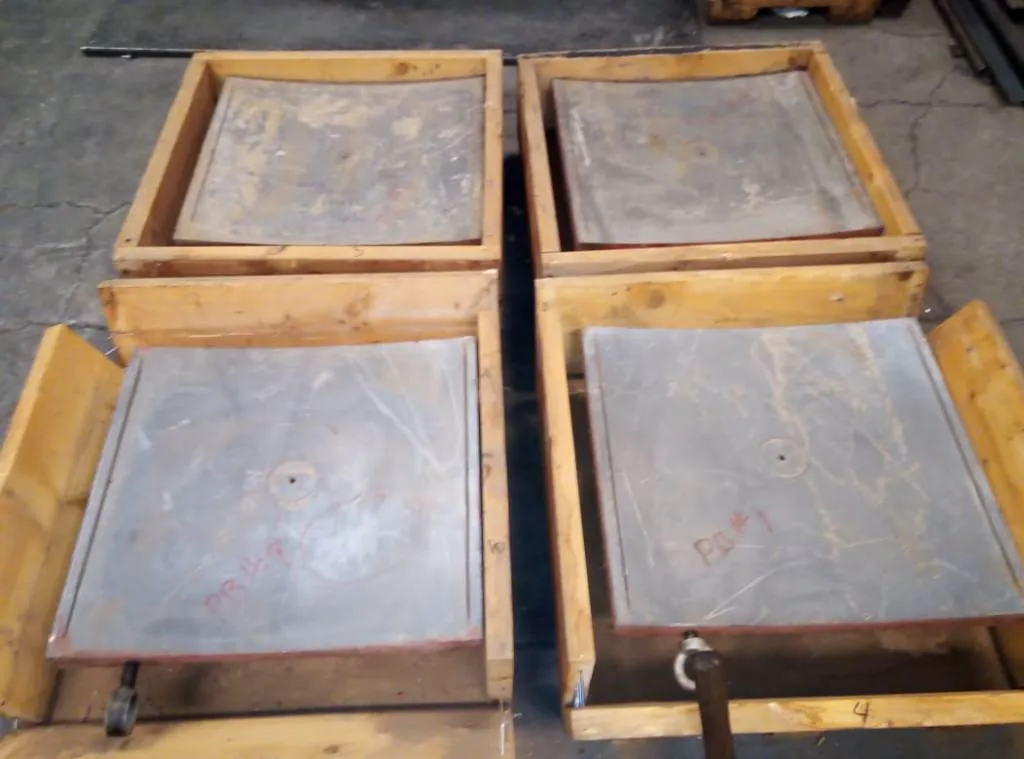
Whitemetal bearing pads showing the lined surface and structural backing
Thermal design

Higher Conductivity Can Lower Temperature, but It Changes More Than Temperature

A more conductive backing can spread heat away from the hot film region, reducing local lining temperature and thermal crowning. That can increase minimum film thickness and operating margin in a design limited by pad temperature.

It can also change the temperature field, hot clearance, pad deformation and heat rejected into the carrier or oil. The benefit must therefore be calculated with the complete thermo-hydrodynamic bearing model rather than assigned from material conductivity alone.

Understand bearing temperature measurements

Load Path

Backing and Support Materials Must Be Considered Together

Pad Backing

Carries the lining and controls local pad bending, heat spreading and the contact geometry machined into the back of the pad.

Pivot Contact

Line, point, spherical or other pivot contact can create high local stress. Hardness, yield strength, contact area and lubrication must be verified.

Base Ring or Carrier

The support ring is a separate component and may require a different material. It must resist indentation, fretting and distortion under the pivot loads.

Housing and Fit

Shell crush, carrier fit, split-face condition and housing stiffness complete the load path and influence the installed bore or pad position.

A high-conductivity pad does not justify an under-strength pivot or base ring. Spherical and point contacts can increase local specific load even when overall bearing load is unchanged.

Selection Inputs

What Must Be Defined on the Drawing

  1. 01

    Operating and Thermal Cases

    Speed, load, oil grade, inlet temperature, flow, predicted film and metal temperature, starts, stops and upset conditions.

  2. 02

    Exact Material Specification

    Grade, chemical composition, product form, heat-treatment or temper condition, hardness range and certification requirements.

  3. 03

    Geometry and Tolerances

    Backing thickness, pad arc, pivot form, shell fit, lining allowance, hot clearance and permitted distortion.

  4. 04

    Bonding Process

    Surface preparation, tinning or interlayer where applicable, casting route, bond acceptance and process qualification.

  5. 05

    Chemical and Electrical Environment

    Oil chemistry, water, sulphur compounds, purchaser copper restrictions, galvanic interfaces and shaft-current protection.

  6. 06

    Inspection and Repair

    Material verification, dimensional inspection, bond testing, surface examination, traceability and future re-lining route.

Repair and Re-Lining

Preserve the Backing as an Engineered Component

Before stripping

Record the Evidence

Map lining cracks, wipe, exposed backing, bond loss, pivot marks, fretting and temperature-sensor positions before removing the old metal.

After stripping

Inspect the Body

Check dimensions, cracks, corrosion, erosion, previous welds, contact damage and distortion. Confirm material identity rather than relying on colour.

Before re-lining

Restore the Specification

Use the approved preparation and bonding route for the identified grade. A process suitable for carbon steel cannot automatically be applied to bronze, CuCrZr or cast iron.

After machining

Verify the Complete Bearing

Confirm lining thickness, bore or pad geometry, pivot height, bond integrity and surface condition using the drawing and applicable inspection standards.

Common Questions

Bearing Backing Materials FAQ

Is the backing the bearing surface?

Normally no. The whitemetal lining is the running surface. The backing provides structure and heat transfer beneath it.

Why is steel widely used?

Steel combines stiffness, strength, availability, cost and established manufacturing practice. Its lower conductivity than high-copper alloys can become limiting in thermally demanding pads.

Why use CuCrZr rather than pure copper?

CuCrZr is selected to combine high conductivity with useful mechanical strength and resistance to softening in a controlled material condition. Pure copper is generally too soft for many structural pad and pivot duties.

Is bronze backing the same as solid bronze?

No. Bronze-backed whitemetal still runs on a bonded whitemetal layer. A solid bronze bearing has a bronze running surface and different tribological behaviour.

Does copper backing always improve a bearing?

No. It can improve heat transfer, but material strength, hot geometry, expansion, pivot contact, bond design, chemistry and cost must suit the application.

Can backing be changed during repair?

Only as an engineered redesign. Changing it normally means manufacturing a new pad or shell and recalculating thermal, structural and oil-film performance.

Technical Basis

The backing comparison was cross-checked against Waukesha Bearings' Introduction to Fluid Film Bearing Materials, its guidance on Babbitt backing and tilting-pad material options; Kingsbury guidance on journal pad backing materials; and Copper Development Association information on high-copper CuCr and CuCrZr alloys. Material-family comparisons are qualitative; use certified properties for the specified grade, section and heat-treatment condition.

Need to Select or Upgrade a Bearing Backing?

Send the bearing drawing, operating data, oil conditions and failure history for a thermal and structural design review.