
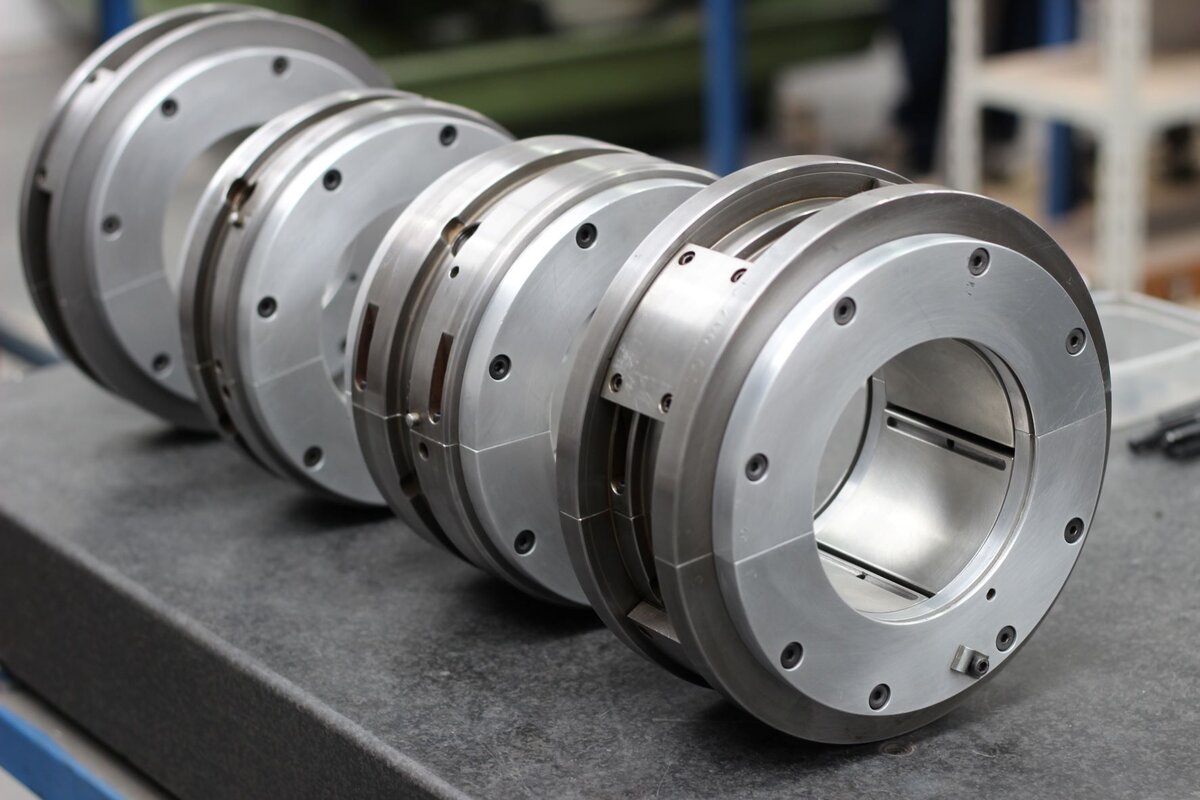
LEG Journal Bearing Re-Engineering
Reverse engineering leading edge groove journal bearings from incomplete housings — delivering four new bearing assemblies when original parts were unavailable and no drawings existed.
Rotating Equipment
Reverse Engineering & Manufacture
LEG Journal Pads
4 Complete Assemblies
Equipment Restored to Service
Overview
When the housings arrive without the bearings — and no drawings exist.
Re-engineering is a practical solution when original spare parts are unavailable, too expensive, or have excessive lead times. Using existing components as a starting point, Oiltech can reverse engineer, design, and manufacture new bearings to restore equipment to full operation.
This order took an unexpected turn when the samples arrived. Four LEG journal bearing housings were received — but without the journal pads. The pads had likely been donated for other bearings, or simply assumed to be scrap. The housings also had broken and missing oil transfer tubes, though they were otherwise in good condition with end covers intact.
The task was to reverse engineer the complete bearing assembly from the housings alone, design new journal pads, and manufacture four complete assemblies — all without original drawings.

Project Phases
From empty housings to complete bearing assemblies.
Phase 1 — Inspection & 3D Modelling
Creating the engineering baseline from physical components.
Work started by re-engineering and creating 3D models of the housings and end covers. These models captured the precise internal geometry and formed the basis for the new journal pad design. Every dimension was taken from the physical parts — there were no reference drawings to work from.
Phase 2 — Pad Design
Engineering new journal pads to fit existing housings.
The pad design was generated by applying bearing design expertise, ensuring the new parts would fit the existing housings precisely, align with the oil transfer tubes, match the current shaft diameters, and have appropriate journal bearing preload for reliable operation. The design had to account for the leading edge groove geometry specific to this bearing type.
Phase 3 — Manufacturing & Clearance Verification
Precision manufacture with lift check validation.
During manufacturing, the running clearance of the bearings was verified using a lift check (also known as a "bump check"), performed in the horizontal plane using a mandrel to replicate the journal. This ensured the correct operating clearance was achieved before final assembly — critical for reliable operation of the leading edge groove design.
Phase 4 — Assembly & Delivery
Four complete assemblies delivered within weeks.
The design was approved for four bearing assemblies and production completed within a matter of weeks. The new journal pads were fitted to the original housings along with new oil transfer tubes and new o-rings — restoring the assemblies to full operational condition and ready for installation.

3D model created from physical inspection of the housings and end covers.

Lift check — verifying running clearance using a mandrel to replicate the journal.

Completed assemblies — new pads fitted to original housings with new oil transfer tubes.
Design Insight
No pads, no drawings — but the housings told us what we needed to know.
The internal geometry of the housings, combined with the oil transfer tube positions and end cover dimensions, provided enough engineering data to design journal pads that would fit precisely and operate reliably. The key was systematic measurement, careful interpretation of the leading edge groove geometry, and applying bearing design expertise to fill in what the physical evidence couldn't provide directly.
Key Outcomes
What the project delivered.
Reverse Engineered
Complete bearing assemblies designed from housings alone — no original drawings required.
Fast Turnaround
Four complete assemblies manufactured and delivered within weeks.
Equipment Restored
Original housings returned to full operational condition with new components.
Engineering-Led
3D modelling, design expertise, and verified clearances ensured reliable performance.
Capabilities Demonstrated
Reverse engineering from physical evidence alone.
This project required Oiltech to work from incomplete physical samples with no reference drawings — combining systematic inspection, 3D modelling, bearing design expertise, and precision manufacturing into a single coordinated programme.
More Case Studies
Have a Bearing Challenge That Needs More Than an Off-the-Shelf Answer?
Oiltech Bearings works with OEMs, service centres and end users to solve complex bearing problems — from emergency repair to full re-engineering programmes.