Which Boundary?
Lining only, complete pad or shell, all oil-wetted parts, or every component exposed to process gas?

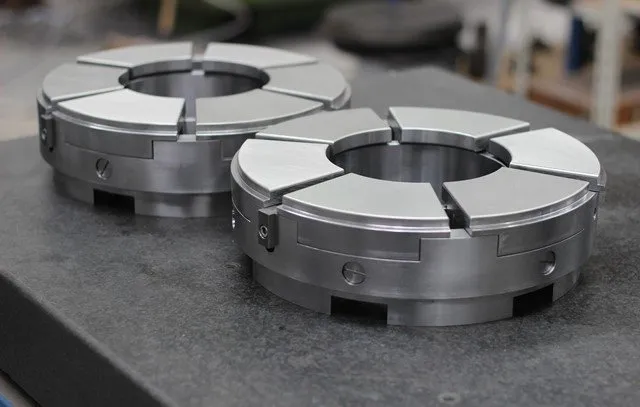
Define the chemistry, component boundary and verification method before using this material description.
The phrase normally communicates a chemical restriction, not a complete bearing specification. It may refer only to the lining or to every component exposed to a process fluid. The drawing or purchase specification must therefore define the alloy chemistry, maximum residual copper, backing and bond materials, scope boundary and acceptance test.
A technically useful specification answers all four before material is purchased or cast.
Lining only, complete pad or shell, all oil-wetted parts, or every component exposed to process gas?
No intentional addition is not a test limit. State maximum copper by mass and how residual content is treated.
Specify every principal alloying element and impurity limit, not copper alone.
Define certificate, analytical method, sampling location, detection capability and acceptance authority.
Conventional tin-based Babbitt uses a soft tin-rich matrix with harder intermetallic phases. Copper contributes copper-tin phases that help support load and control the alloy structure, while antimony contributes tin-antimony phases.
Removing or sharply reducing copper changes solidification, microstructure, hardness, fatigue behaviour and casting practice. A copper-free formulation must therefore be qualified as its own bearing alloy rather than treated as standard Babbitt with one ingredient omitted.
Standards do not remove the need for a grade: ASTM B23-20(2025) covers eight commercial Babbitt alloys, while ISO 4381:2011 covers tin casting alloys for multilayer plain bearings. A general reference to either standard does not state the project-specific copper limit or complete bearing construction.
Confirm the actual fluid, concentration, water content, temperature and exposure route rather than selecting from the process name alone.
Gas entering the lube or seal-oil system can promote sulphide formation and depletion of copper-bearing phases. The result can include deposits, softening, clearance change, overheating and fatigue.
Ammonia service can restrict copper alloys. The requirement may apply more strongly to a copper-alloy backing, carrier or fitting than to the running layer alone.
Water, acidic oxidation products and decomposed additives can attack lead- or copper-containing bearing systems. Oil chemistry must be investigated with the material.
A purchaser may prohibit copper for process safety, product purity or common-material control even where no previous bearing corrosion has occurred.
Whitemetal, overlay, aluminium-tin, polymer or another qualified surface.
Steel, bronze, copper-chrome, CCZ, bond coat, plating and diffusion layers.
Pivot, pad support, equalising system, carrier, base ring, dowels, plugs and fasteners.
Nozzles, tubing, coolers, fittings, instrument pockets and any exposed brazing alloy.
Sensor sheath and installation hardware; electrical conductors may require a clearly defined exception.
Plating can isolate a substrate but does not make the underlying component copper-free. Damage tolerance matters.
Restricts copper for chemical compatibility, process control or another stated reason.
Restricts lead for environmental, occupational, product or regulatory requirements.
Restricts cadmium because of toxicity and regulatory controls.
One requirement does not imply either of the others. State each element, maximum permitted concentration and test basis separately.
Name the fluid, all constituents and trace contaminants, water content, concentration, pressure, temperature and normal or upset exposure.
Identify every in-scope component and surface, including lining, backing, interlayers, pivots, fittings, coatings and permitted exceptions.
State the complete alloy composition and a numerical maximum for copper and every other restricted or controlled element.
Define strength, hardness, fatigue, temperature, bond, lining thickness, finish and hydrodynamic performance requirements.
Specify certificate level, heat or batch traceability, analytical method, sampling plan, detection limit and retest or rejection rules.
Prevent cross-contamination in melting, casting, tooling and finishing, then identify the approved material on drawings and spares.
Review the approved drawing, supplier specification, heat number and certificate. A trade name must resolve to controlled composition and revision data.
Use a method capable of measuring the specified limit. Handheld XRF can be useful for screening but may not prove a low residual threshold or thin-layer chemistry.
Retain deposits and use SEM/EDS or suitable laboratory analysis to distinguish copper sulphide, tin oxide and other corrosion or contamination products.
Preserve oil, filter debris, seal history, gas analysis, water content, acidity, temperature and operating trends before cleaning the bearing.
Not generally. Conventional high-tin grades commonly contain intentionally added copper. Confirm the exact alloy grade and certified analysis.
No. It does not establish a residual limit, analytical method or detection capability. Use a numerical acceptance value.
No. Copper, lead and cadmium restrictions are independent and must each be specified.
It may remove one susceptible phase, but the ingress path, oil condition and compatibility of every other material must still be corrected.
No. Copper-chrome-zirconium is a copper alloy. A coating may isolate it where permitted, but does not remove copper from the assembly.
Oiltech can review a defined alloy and bearing specification against the design, manufacturing, inspection and traceability requirements before confirming feasibility.
The guidance was cross-checked against Waukesha Bearings' bearing corrosion guidance, its paper on fluid-film bearing fundamentals and failure analysis and its aluminium-tin bearing guidance; Mitsubishi Heavy Industries' ammonia-service thrust-pad case; ASTM B23-20(2025); and ISO 4381:2011. The alloy and construction must be approved for the actual machine and process exposure.
Send the process-fluid data, material restriction, bearing drawing, operating conditions and any corrosion evidence for an engineering review.