
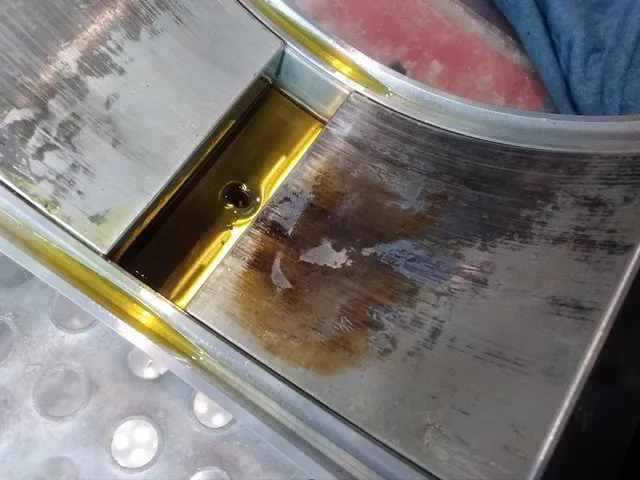
A hard particle can embed in the compliant whitemetal while remaining proud of the surface. It then acts as a cutting tool against the shaft or journal, producing a narrow groove and sometimes long, wire-like metallic swarf.
What the Damage Looks Like
- Fine wire-like metallic debris in or around the bearing
- A local dark, hard inclusion embedded in the lining
- A narrow circumferential groove on the bearing and mating shaft
- Damage concentrated at one persistent cutting point
Likely Contributing Factors
- Grinding or maintenance debris entering an open bearing
- Hard particles left in oil passages after overhaul
- Debris from chromium-rich steels or repaired shaft coatings
- Inadequate cleaning, flushing or exclusion controls during assembly
- Filter bypass or contamination introduced downstream of filtration
Diagnosis and Response
Move From Damage to Root Cause
What to Inspect
- Preserve and identify recovered debris where practical
- Inspect the corresponding shaft track and any repaired coating
- Review nearby grinding, blasting and coating work during overhaul
- Examine galleries, housings, filters and oil samples for similar particles
- Check assembly cleanliness and component protection records
Corrective Actions to Consider
- Remove the embedded particle and all secondary debris
- Clean and flush the complete affected lubrication circuit
- Repair and verify the shaft surface where it has been machined
- Improve exclusion, covering and cleanliness controls during maintenance
- Review filtration location and bypass paths for the operating system
Repair or Replace?
The bearing and shaft should be assessed as a pair. A shallow local mark may be recoverable after the source is removed, but deeper scoring or embedded contamination can require re-lining and shaft restoration followed by dimensional and surface-finish verification.
Diagnosis Note
Not every strand of debris proves classic wire-wool damage. Material identification and matching the bearing mark to the shaft track help distinguish a cutting particle from general wear debris or damage created during dismantling.
Need an Engineering Assessment?
Send photographs, operating data and failure history for an initial review by Oiltech Bearings.